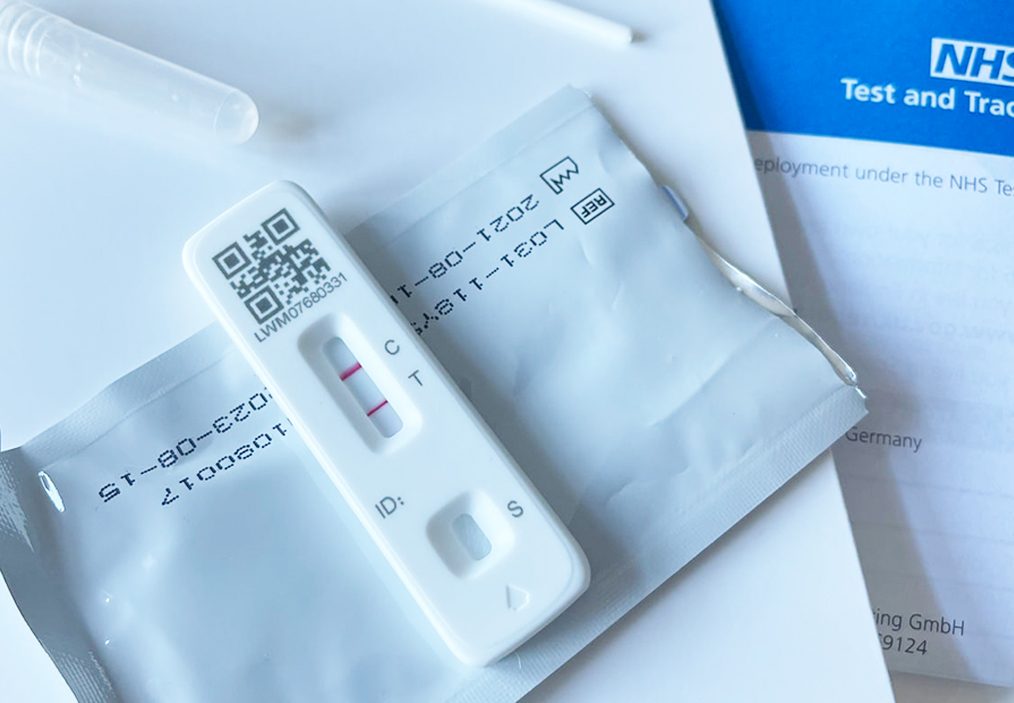
As of today, Asymptomatic people who test positive on lateral flow tests will no longer need a follow-up PCR to officially begin their isolation period.
On the introduction of the new measure in England today, health chiefs have said that, while infection rates remain high across the country, the vast majority of people with positive lateral flow results can be confident they have COVID-19.
Before the introduction of the measure today, people without symptoms who tested LFT positive were asked to order a PCR test, and were then told to only begin their isolation period when they get the PCR result, which effectively required them to isolate for longer than seven days.
Awaiting PCR results was said to be a cause of delay to the official start of isolation for hundreds of thousands of people.
Growing delays in getting PCR test results were also widely reported across the UK.
As lateral flow tests should only be taken by people who do not have COVID symptoms, the UKHSA confirmed that people experiencing the three official COVID symptoms – which are a high temperature, a new, continuous cough, and a loss or change to your sense of smell or taste – will still be expected to get a PCR, however.
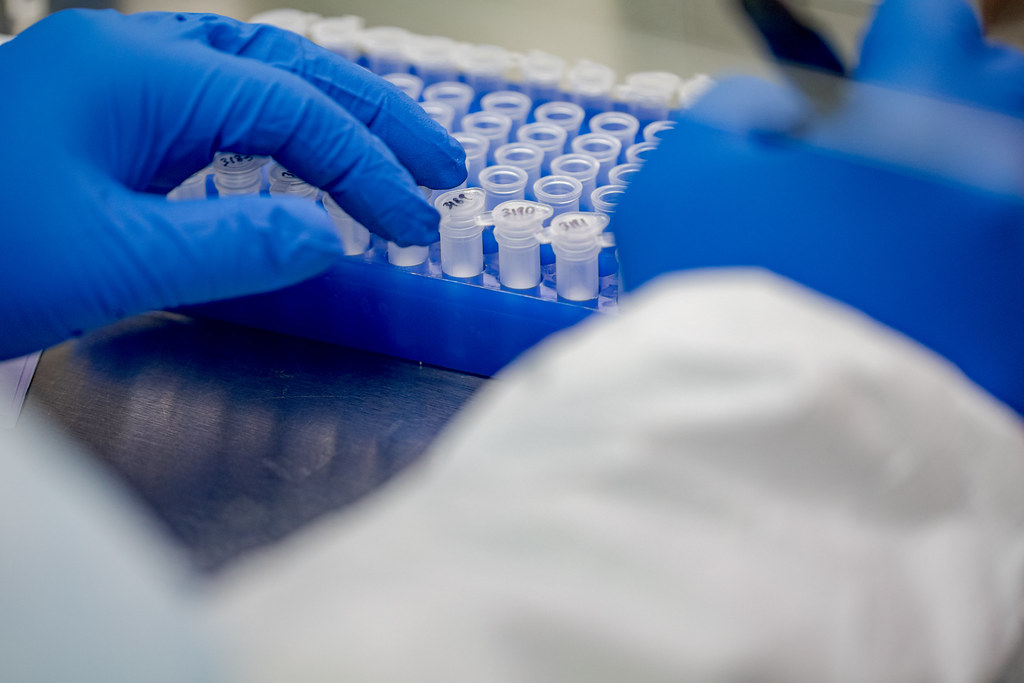
Follow-up PCR tests are no longer required for asymptomatic people who test positive on lateral flows / Credit: Flickr (Tom Wolf)
People who test positive on lateral flow tests will still need to isolate for at least seven days and register their positive results, and those with symptoms should self-isolate even if they have had a recent negative lateral flow test, as rules for symptomatic people have not changed.
Speaking on the introduction of this temporary measure today, Dr Jenny Harries – Chief Executive of the UKHSA – said: “This is a tried and tested approach.
“With COVID cases high, we can confidently say lateral flow tests can be used to indicate COVID-19 without the need for PCR confirmation. If you test positive on an LFD, you should self-isolate immediately and register your result to allow contact tracing to take place [and] it also remains really important that anyone experiencing COVID-19 symptoms self-isolates and takes a PCR test via gov.uk, or by phoning 119.”
“I’m really grateful to the public and all of our critical workers who continue to test regularly and self-isolate when necessary, along with other practical and important behaviours to limit transmission of the virus,” Dr Harries continued.
“This is the most effective way of stopping the spread of infection and keeping our friends, families and communities safe.”
The UKHSA said that the this new change is just a “temporary measure” while COVID rates remain high and will free up capacity in laboratories for PCR tests for those who do have symptoms, and would allow those who are asymptomatic – about 40% of cases – to return to work more quickly.
Under current guidelines, anyone who tests positive for COVID-19 will be able to leave self-isolation seven days after the date of their initial positive test, providing they receive two negative lateral flow test results, taken 24 hours apart, on days six and seven.
Featured Image – Unsplash (John Cameron)
UK News
What is going to be included in the UK’s planned under-16s social media ban?
In case you missed the landmark announcement yesterday, it has been confirmed that social media is to be banned for under-16s in the UK.
That’s right – in what is said to be a bid to ‘give kids their childhood back’ and set ‘a new normal’ for future generations by kickstarting a cultural shift, the Government has announced that social media platforms will be banned from offering their services to under-16s – meaning less time for scrolling and more time for play.
The Government says it plans to use the same model for a social media ban as Australia, which was introduced back in 2024.
But what exactly does that mean? And what social media platforms are set to be included within the upcoming ban and which ones aren’t?
Well, according to the Government and Technology Secretary Liz Kendall, the UK’s ban would capture user-to-user platforms, whose purpose is to enable social interaction, allow users to post their own material, alongside algorithms.
The Government has announced a social media ban for under 16s / Credit: Julian Christ (via Unsplash)
The ban will, therefore, include popular social media platforms like Snapchat, TikTok, YouTube, Instagram, Facebook, and X.
But crucially, at this time, it is not intended for messaging services like WhatsApp to be included.
The Government says it is also planning to go even further than any other country, as on top of a blanket ban on social media, world-leading blocks on harmful functions – such as livestreaming and stranger communication with children – will also be blocked for under-16s, and will apply to a wider range of online services, including on gaming sites.
Restrictions on these functionalities will also be on by default for 16- and 17-year-olds to prevent what ministers are calling a ‘cliff-edge’ at 16.
And to go even further, the Government says it will be ‘looking in more detail’ at the potential to introduce overnight curfews and breaks in infinite scrolling for those under 18 – with more information to be provided on this next month.
“This is a decisive first step which marks a clear choice to put children’s wellbeing first and give them a healthy life online,” the Government said in a statement. “We stand ready to take further measures in the future.”
Speaking on the upcoming ban and further restrictions, Prime Minister Keir Starmer said: “Parents want to keep their kids safe and happy, but the online world has made that harder than ever.
“I’ve heard first hand from families crying out for change and we will do right by them.
“That’s why we’re going further than any country in the world by banning social media for under-16s and putting wider protections in place to give kids their childhood back.
“This is a line in the sand. Tech giants had their chance and failed, but we’re stepping in to protect children, back parents and set a new normal for future generations.”
Pioneering Bradford artist David Hockney has passed away aged 88
Clementine Hall
David Hockney, one of Britain's most influential and recognisable artists, has sadly died.
Born in Bradford in 1937, David Hockney built a career spanning more than six decades and became one of the most influential figures in contemporary art.
He was best known for his vibrant paintings, from the iconic swimming pools of Los Angeles to the sweeping landscapes of Yorkshire and Normandy.
And of course you can't forget the adorable paintings of his sausage dogs Stanley and Boodgie.
This morning on Friday 12 June, it was sadly announced that David Hockney had passed away - just one month prior of his 89th birthday.
Admired by critics and the public alike, Hockney's work was exhibited around the world and attracted record-breaking prices, cementing his place as one of the defining artists of the modern era.
Most recently, his incredibly immersive exhibition 'Bigger & Closer (not smaller & further away)' was a hit across the country, proving his work still resonated with the people of today.
His work at Salts Mill has remained in exhibit for years, including his special digital drawings that he did on his iPad.
His death marks the end of a truly extraordinary career, but his influence on British culture and contemporary art will endure for years to come.
A true West Yorkshire icon that will be missed by many from across the globe. RIP David.