Those at a private school are twice as likely to have been encouraged to apply to a Russell Group university compared to state school students.
A new report from social mobility group Zero Gravity, has found that there's far more than meets the eye in the difference between state and private schools.
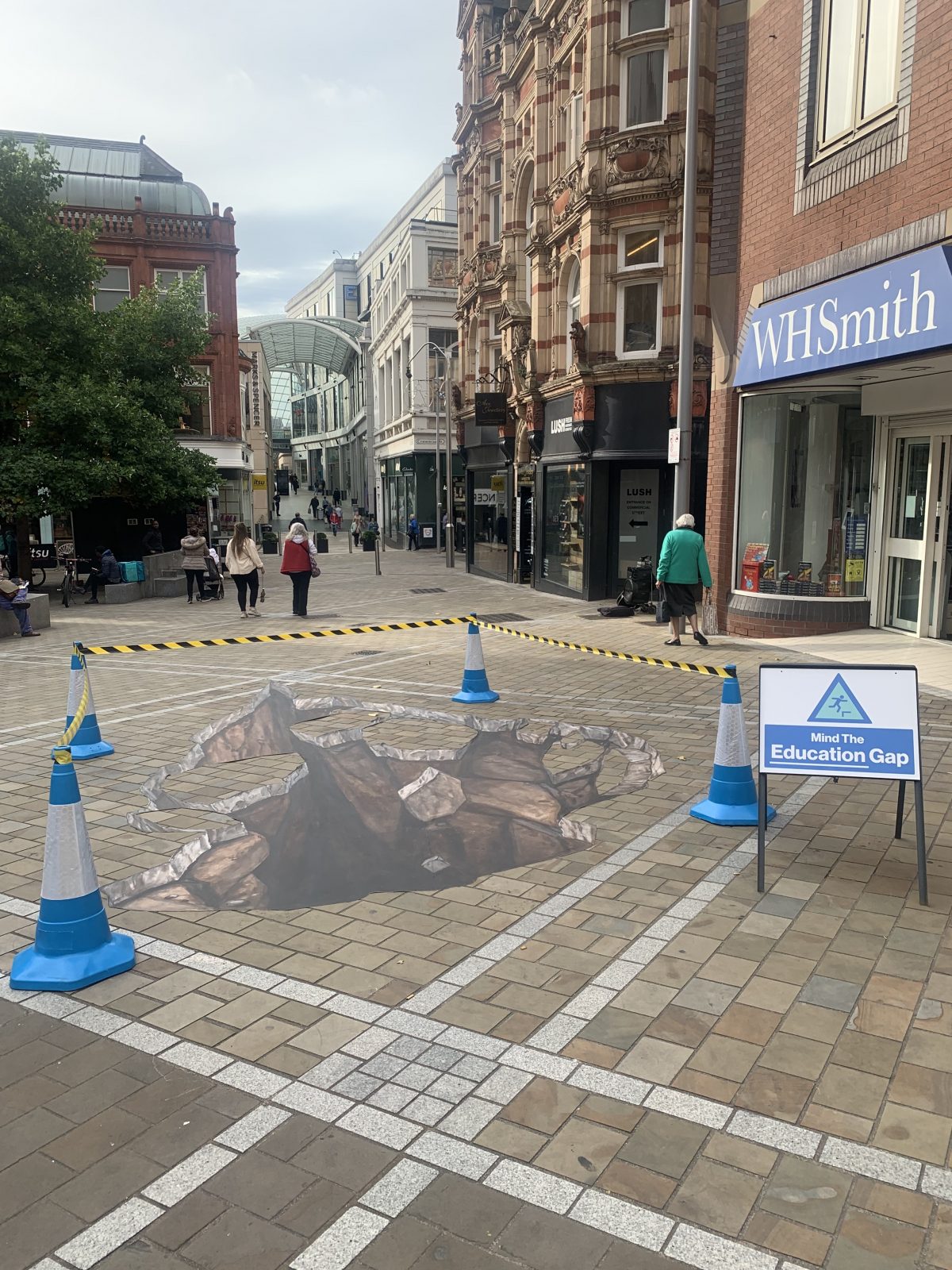
After an interactive art piece hinting at the report's findings in Leeds last week, the report is finally ready to go public.
Mind The Education Gap was installed on Lands Lane in Leeds city centre last week. / Image: The Hoot Leeds
The study has found that, "in line with popular belief, the power of networks often starts at home", finding that almost two thirds of students from middle class backgrounds (64%) believe their family has the knowledge to assist them with their university application, whereas 43% of those from working class backgrounds had the same opinion.
One important finding is the knowledge to help with a university application gap narrows to 8% when comparing state educated with private school students, which the reports explains as a suggestion "that the affluence of family members is more important in driving perceptions of direct family support than school type".
The study also found that networking was significantly different, depending on what school students attended. Compared to state school students, private school students are:
More than twice as likely to know an accountant (7% v 16%)
Twice as likely to know a doctor (13% v 25%)
Four times as likely to know a lawyer (8% v 36%)
Seven times as likely to know a banker (2% v 14%)
Seven times as likely to know a politician (2% v 14%)
Students at private schools are also 24% more likely to imagine themselves attending a Russell Group university and 59% of state educated students worry they wouldn’t have the same economic support as others at university, compared to 6% of privately educated pupils, according to the Zero Gravity report.
Joe Seddon, Founder and CEO of Zero Gravity issued the report after being inspired by his own experience of transitioning from a state school to applying and attending the University of Oxford.
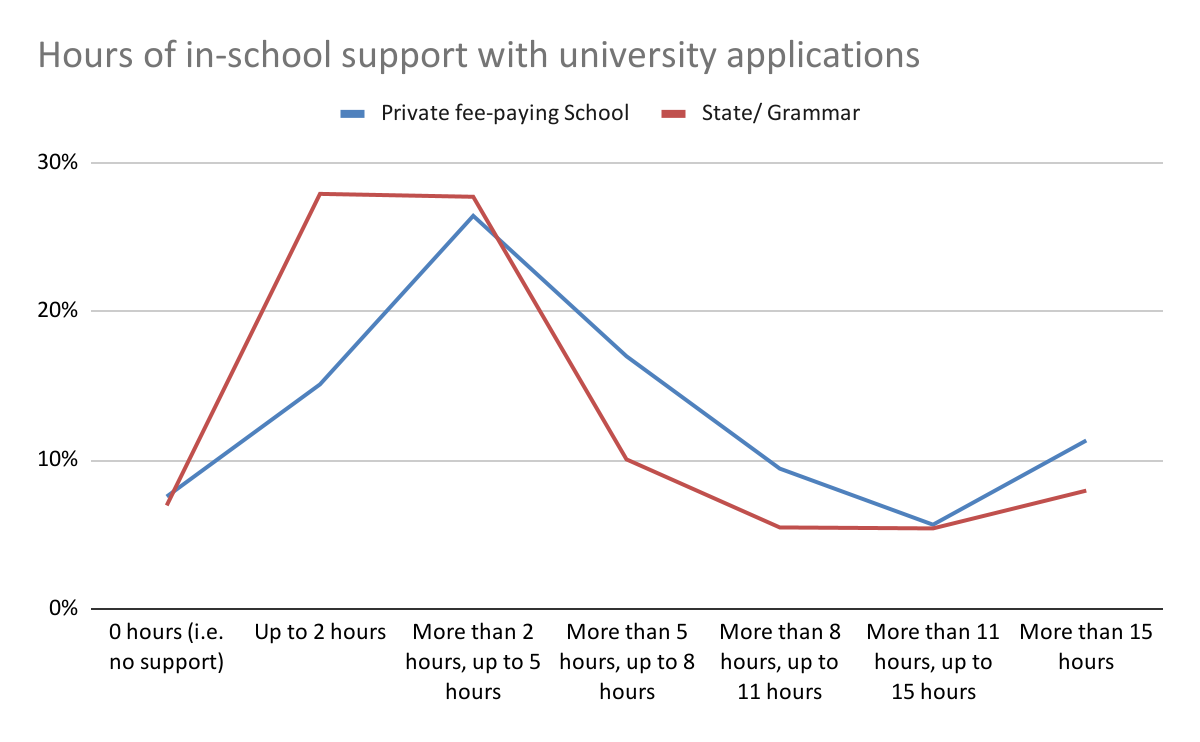
"It may surprise some fee-paying parents that the level of in-school support with university applications reported by state school pupils is mostly in line with that received at private schools (see below). Beyond a handful of aberrations, state school pupils are receiving on average no less contact time than their fee-paying peers. " - Zero Gap Report
Determined to ensure social mobility doesn't reflect on other students, Joe founded Zero Gravity, a mentoring platform that has aided over 3000 students from low-income backgrounds in their university application process and beyond, stating: "we’re now mentoring these students into the UK’s leading graduate employers across finance, law, professional services, and technology - ensuring our members are defined by their potential, not by a postcode lottery."
After conducting its own report, the company can reveal that access to a professional network is a strong predictor of a student’s likelihood to apply and win a place at elite universities.
"Talent is spread evenly, but opportunity is not." Joe explains in the Foreword of the report.
"This fact of life is so embarrassingly obvious that it often goes unsaid. However, things don’t have to be this way. Western societies have evolved dramatically over the past two centuries to spread opportunities more widely and open access to elite institutions."
The study concludes that "until access to a professional network is no longer determined by birth, geography or education, the link between background and opportunity will not be broken [...] but the way things are is not the way things have to be."
Zero Gravity is just one example of a social-led enterprise that's striving to close the gap of networking, knowledge and expectation between state and private schools.
So far this year, 78% of Zero Gravity students have won a place at their first-choice university, so that "both talent and opportunity can be evenly spread."
Leeds City Council is asking people for their views about transport options and public space in the city centre.
Got some thoughts and feelings about how you'd like Leeds city centre to operate? Well now's your time to speak up.
Because people are being invited to give their feedback on current issues and improvements they would like to see around St. Peter’s Street, York Street, Eastgate, Duke Street, Kirkgate, Crown Point Road, Marsh Lane and East Street.
This area of Leeds is vital for those travelling in and out of the city, with many integral and busy bus routes passing through here.
The area is also home to leisure, cultural and educational facilities, as well as Leeds bus station, and has a large and growing residential population, making it a key area for people using the bus, walking, cycling, and travelling by car.
Between 2014 and 2024, there were 260 road related casualties in the area, including 32 serious casualties and three fatalities.
The council and West Yorkshire Combined Authority will use feedback to develop plans for safer ways of travelling for everyone and more welcoming public spaces.
Councillor Tom Hinchcliffe, Leeds City Council’s executive member for transport and planning, said: “This is an important step towards a transport system that prioritises efficient public transport and supports all forms of travelling, making it easier and safer for people to get around the city.
“Public spaces are there to be used and enjoyed by everyone, and it's important that we make these spaces welcoming, accessible and well connected.
"We urge everyone that travels through this area — whether you walk, cycle, drive, or take the bus - to take part in the consultation and share your views. By sharing your experience of travelling in the area, we’ll be able to make the right improvements to make it a safer, more welcoming space for everyone.”
Have your say before Tuesday 17 November by filling in a short survey, or attending a drop-in event. You can view the drop-in events here.
Leeds City Council confirms plans to repair historic Lower Kirkgate with work set to begin this month
Clementine Hall
Leeds City Council has confirmed that work to stabilise buildings on Lower Kirkgate is set to begin later this month, with repairs expected to take around 20 weeks to complete.
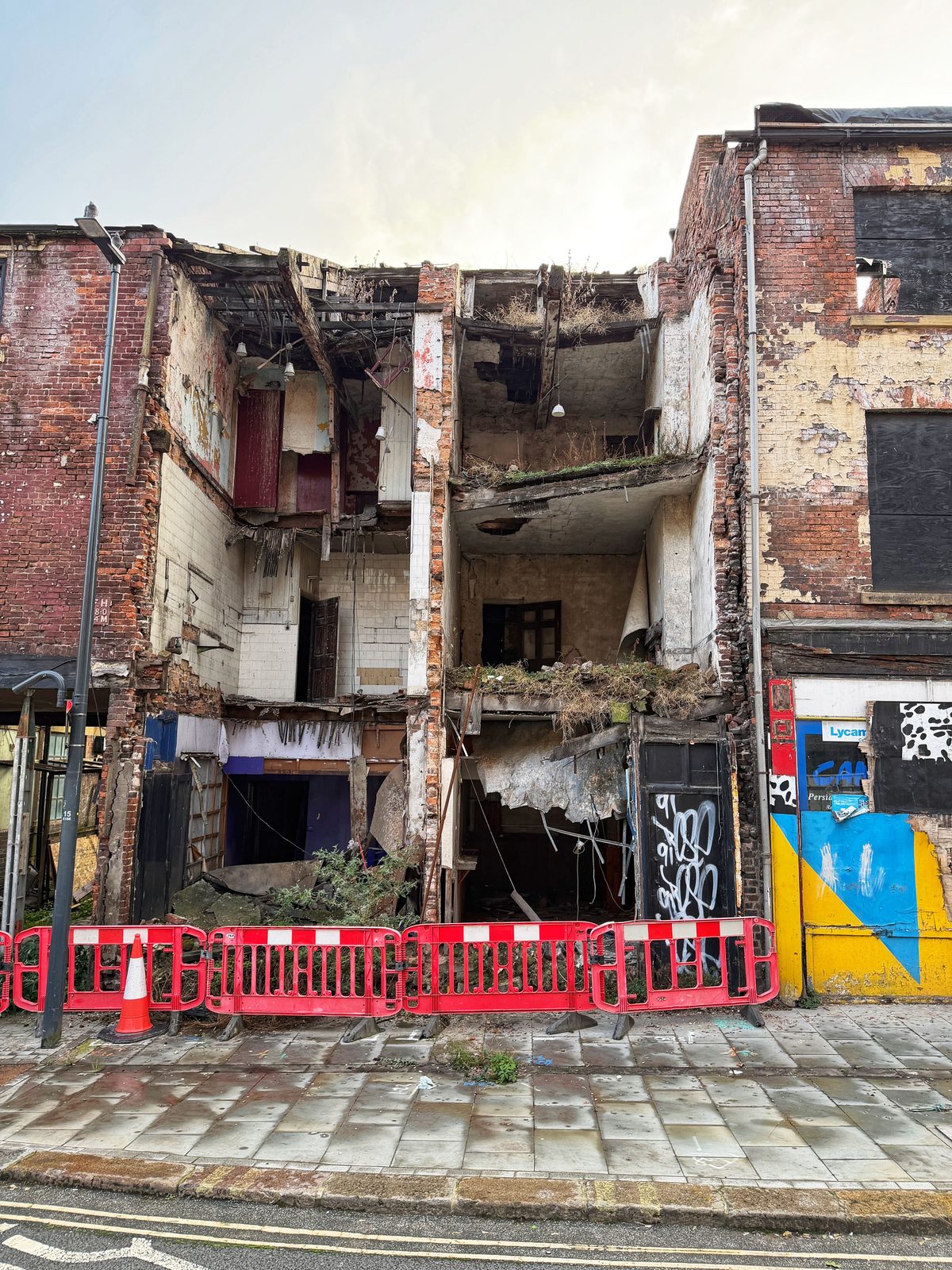
Back in 2024, Lower Kirkgate in Leeds city centre was closed following the partial collapse of a building, leaving one of the city's oldest streets inaccessible.
Since then, the street has remained closed while plans were developed to address the structural issues affecting the buildings.
Now, almost two years after the initial incident, the council has confirmed that a contractor has been appointed to carry out the work.
The buildings are privately owned, but Leeds City Council says it will step in to carry out the stabilisation work to prevent further deterioration and protect the historic properties.
Image: The Hoot Leeds
A spokesperson for Leeds City Council said: “We are pleased that, following months of careful planning and preparation, we are now in a position to begin stabilising these privately owned buildings.
“A contract has been awarded for the work, which is scheduled to get under way later this month and is expected to take around 20 weeks to complete.
“It should be stressed that the situation on Lower Kirkgate is not of the council's making, with the owners of the buildings allowing their condition to deteriorate over many years and then failing to take the necessary steps to address the resultant structural issues.
“By stepping in and carrying out this work itself, the council will be able to arrest the deterioration of important heritage assets on one of Leeds’s oldest streets. As always, we thank the local community for their continued patience and support.”
Further details about the work, including when the street may be able to reopen, have not yet been confirmed.

 Sophie Smith -
11th October 2022
Sophie Smith -
11th October 2022