According to a new study by Private Rehab Clinic Delamere, Leeds has been named the second-worst city in the UK for dangerous drinking.
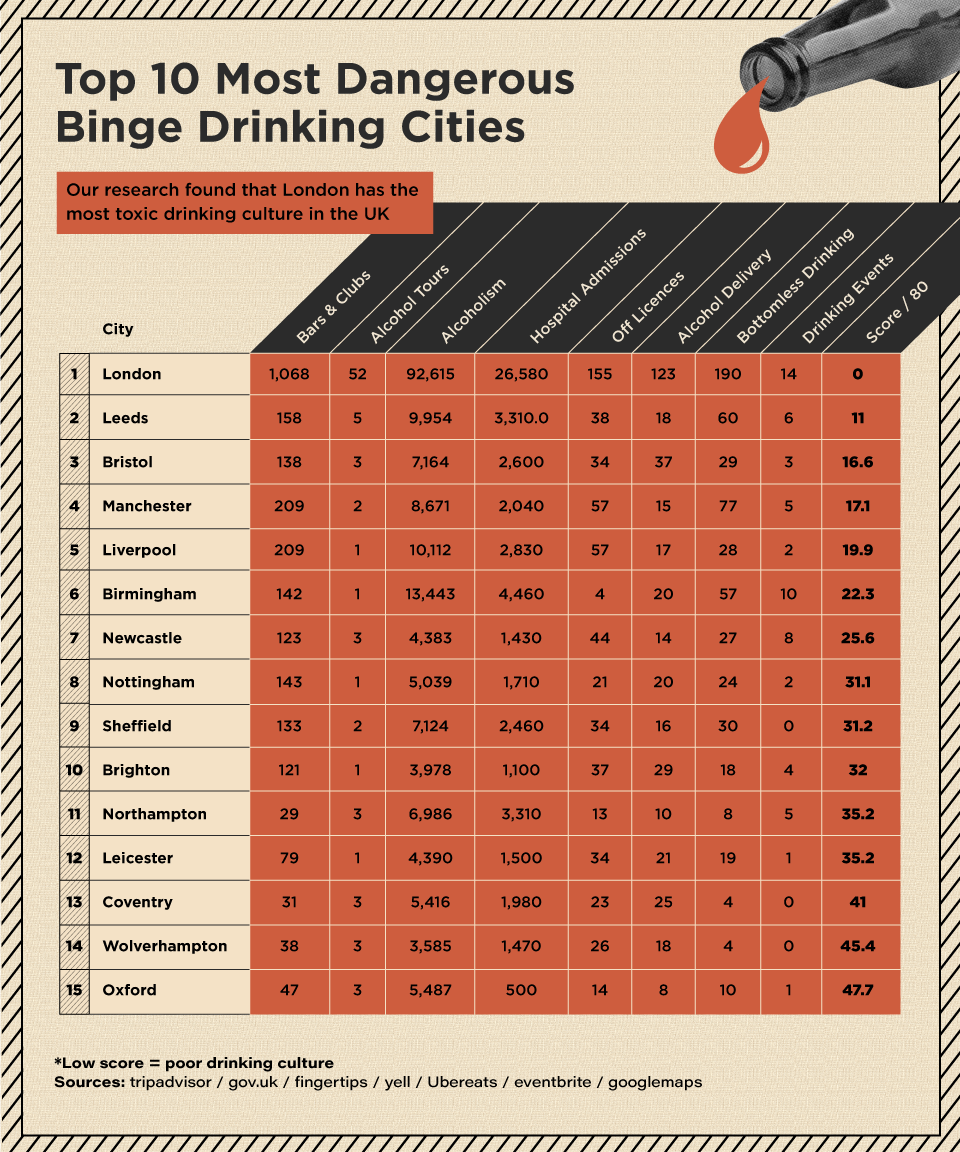
The study ranked each city in the UK out of a possible 80 and the team determined a rate of binge drinking by considering factors like: the number of clubs and bars, alcoholism rates, number of off-licences, alcohol tours and bottomless drinking locations.
Whilst we are fully aware that our bottomless brunch offerings are extensive compared to quite a few other UK cities our size, factors like alcoholism rates are far less likely to be known to the public.
Overall Leeds was given second place as the worst city for drinking culture in the UK, with a score of 11 out of 80.
This was based on a bottomless drinks score of 0.8/10, with 60 recorded locations and events offering free-flowing booze. 3,310 hospital admissions were documented between 2019-2020 and finally, there were 9,954 recorded alcohol dependency cases between 2018-2019.
Completing the top three was Bristol with a score of 16.6 out of a possible 80.
Taking the top spot however was the nation's capital. The research revealed that London had the most dangerous drinking culture in the UK with an overall score of 0 out of a possible 80.
As the most populated city in the country, London had a huge 26,580 alcohol-related hospital admissions recorded between 2019-2020, 190 bottomless drinking locations and 1,068 bars and nightclubs that all contributed to its toxic drinking culture.
The Top 10 Most Dangerous Cities for Drinking Culture
London - 0/80
Leeds - 11/80
Bristol - 16.6/80
Manchester - 17.1/80
Liverpool - 19.9/80
Birmingham - 22.3/80
Newcastle - 25.6/80
Nottingham - 31.1/80
Sheffield -31.2/80
Brighton -32/80
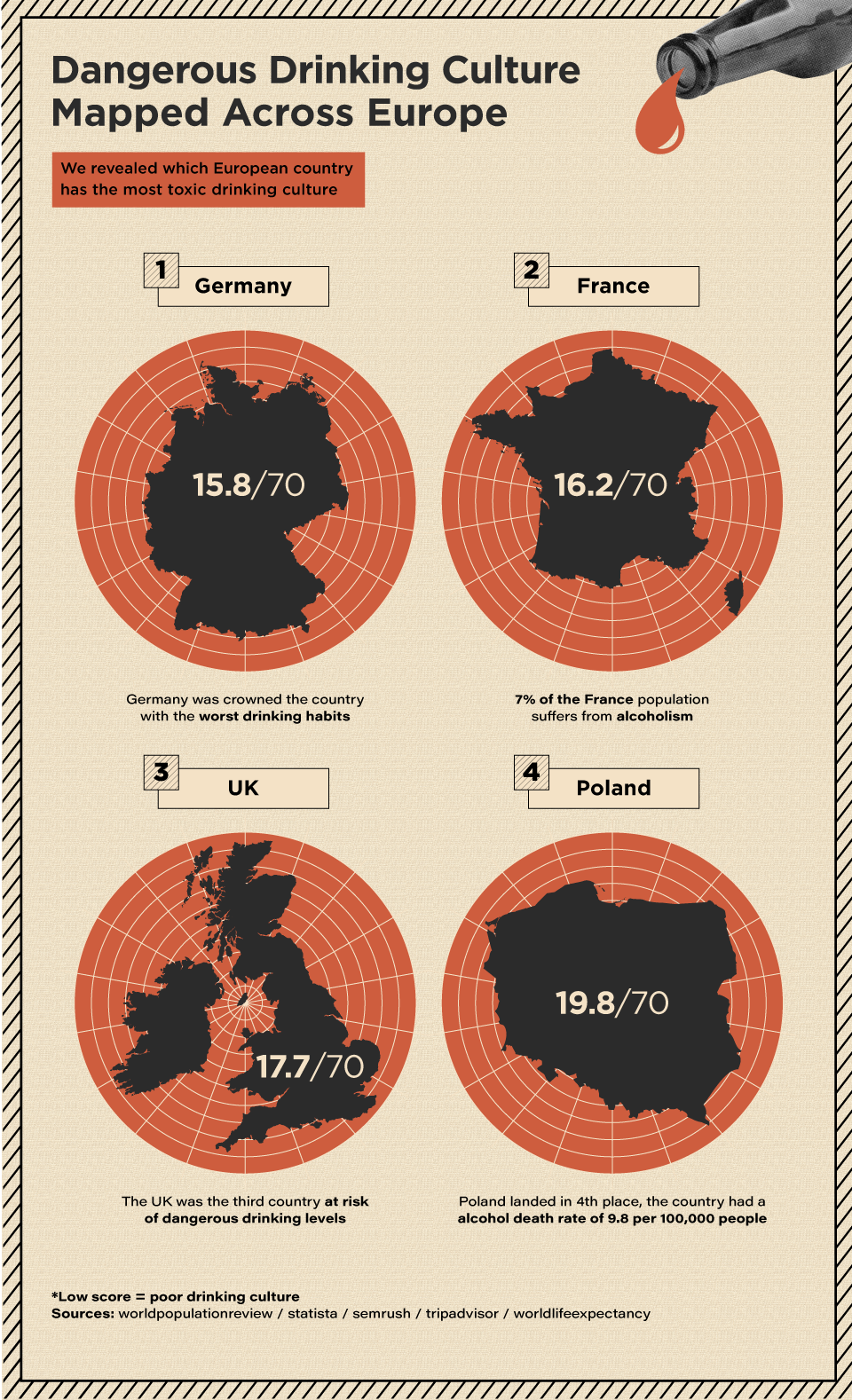
When compared against other countries in Europe, the UK was in the top three "at risk of dangerous drinking levels" with a score of 17.7/80.
Martin Preston, Founder and Chief Executive at Delamere, shared his insight on why binge drinking rates are so high in the UK:
“The coronavirus pandemic caused an alarming spike in binge drinking levels across the UK, the isolation caused many people to turn to drinking high levels of alcohol at home.
Drinking at home, rather than at a pub, removes the need to wait between drinks and also the worry around spending too much money. For example, the average bottle of wine in the UK costs around £6, which is what some glasses of the same wine can cost in pubs and bars.
The endless hours spent at home during the lockdowns meant that 18.1% of people were drinking at a high-risk level. While one in four (22%) of adults had increased their alohol consumption, causing 10% of people to worry about the strain of alcohol on their health.
As well as this, our research found that the top three cities with the highest binge drinking problems had a large number of drinks delivery services, so the need to leave the house to buy alcohol was eliminated.
For more information about drinking culture in the UK and the results of this study, including tips for combatting binge drinking and alcohol dependancy, visit the Delamere website.
Feature Image- Fred Moon, Unsplash
All infographics were supplied by Delamere / JBH
News
Government to investigate companies like Trainline and Virgin Atlantic for ‘misleading’ pricing
The Government is investigating a number of companies for 'misleading' pricing practices.
The Competition and Markets Authority (CMA) has launched three new consumer protection investigations into Trainline, Virgin Atlantic, and RED Driving School over concerns that customers were not shown the total price upfront when buying things like train and coach tickets, holidays, or even driving lessons.
The investigations are part of a wider CMA clampdown on misleading pricing practices - in this instance, where mandatory charges are separated from the headline price, or added later in the buying process, which is known as drip pricing.
These practices leave consumers facing 'unexpected' costs or having to calculate the so-called true cost themselves.
Such practices can also impact competition between businesses, as a firm using drip pricing may falsely appear to be cheaper than a competitor pricing correctly, and therefore attract more customers.
Trainline is being investigated over whether all mandatory fees have been included in the upfront prices displayed to consumers buying tickets in advance on its app and website, while Virgin Atlantic's investigation will focus on whether mandatory resort fees and local taxes have been included in the upfront prices shown to customers buying package holidays.
Trainline and Virgin Atlantic are among the companies being investigated for 'misleading' pricing / Credit: Northern | Aric Cheng (via Unsplash)
RED Driving School is being investigated over how a mandatory booking fee and 'digital' fee have been displayed to people booking driving lessons - specifically whether these fees have been included in the total upfront price.
"At a time when many households are watching every pound they spend, it is important that people are not surprised by extra fees," commented Emma Cochrane, who is the Executive Director for Consumer Protection at the CMA.
"Clear pricing helps people compare offers confidently and choose the option that works best for them.
"Unexpected mandatory charges make this much harder, which is why the CMA initially put these firms on notice over concerns about their pricing practices and is now opening formal investigations."
The CMA says it's at the beginning of its investigations and has reached no conclusions about whether these firms have broken the law.
If it finds there has been an infringement of the law, the CMA can order businesses to pay compensation to affected customers or be charged up to 10% of global turnover.
Featured Image - PNW Productions (via Pexels)
News
Major new phone rule introduced at Wetherspoons after customers are ‘driven nuts’
Emily Sergeant
A major new phone rule has been introduced in all JD Wetherspoon pubs across the UK after customers complain of being 'driven nuts'.
The pub chain - which has nearly 800 branches across the UK - announced earlier this week that it has made the decision to ban people from playing music or videos out of their phones, and from taking calls on loudspeaker.
The ban, which has been introduced effective immediately, follows a rising number of complaints from customers about the noise - with owners saying sounds from smartphones and tablet computers had become an 'increasing problem' in recent years.
Wetherspoon founder and chairman, Tim Martin, says he wants Wetherspoon pubs to be 'an oasis of tranquillity and contemplation'.
A formal statement from the company announcing the ban reads: "Following complaints from customers, who are being driven nuts by other people’s videos and amplified phone conversations, Wetherspoon has asked customers to switch their phones to silent or to use earphones."
Wetherspoons has introduced a new phone rule at all its UK pubs after customers are 'driven nuts' / Credit: Allan Rohmer (via Unsplash)
Tim Martin added: "In order to avoid customers being driven chicken jalfrezi by a cacophony of sound, we are kindly asking phone users to pipe down."
Wetherspoon's ban follows a YouGov poll conducted last year questioning public opinion on a proposition made by the Liberal Democrats of introducing fines of up to £1,000 for 'headphone dodgers' who play music out loud on buses and trains.
62% of people, on average, said they would back this move if it was introduced.
The poll, which surveyed 6,815 British adults, found that almost three-quarters of those over 65 would support the fines, while those aged between 18 and 24 were split 47% to 43% in favour of it.
Early public reactions to Wetherspoon's ban appears to be overwhelmingly positive.